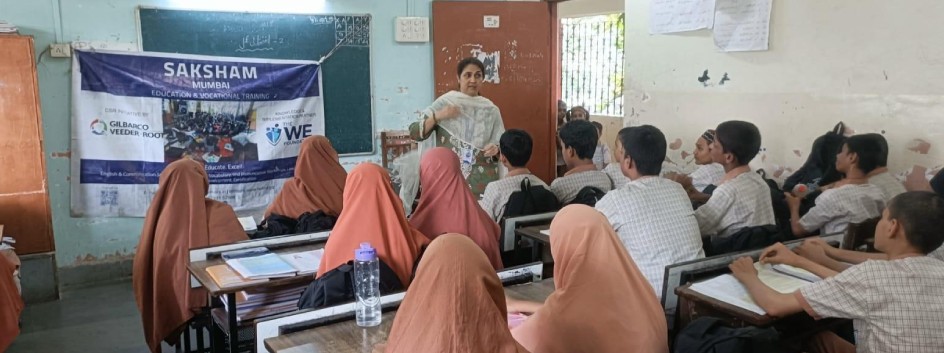
In five BMC schools across Mumbai’s Bandra–Kurla Complex (BKC), Project Saksham is transforming Government classrooms into spaces where children discover that learning can be joyful, relevant, and within their reach. By combining targeted English support, creative arts, and student leadership with health and WASH interventions, Saksham is helping over 10,000 students see school not as an obligation, but as a place where their potential is taken seriously.
For 12‑year‑old Ishan from a Hindi‑medium section, English lessons once felt like a wall he could never climb. Baseline assessments under Saksham identified his level and grouped him with peers who needed similar support. Instead of rote copying, he now learns through picture cards, vocabulary games, and simple stories linked to his daily life. The first time he managed to read a short paragraph aloud in class, his friends clapped, and his teacher wrote “Well done!” on the board next to his name. Ishan has since started helping his younger sister with homework and proudly introduces himself as someone who “can read English now,” a shift that has changed how he thinks about his future.
In a girls’ section in Bharat Nagar, Reshmi had always stayed quiet, convinced that “good English” was only for children in private schools. Saksham’s English and Art & Craft sessions encouraged her to express herself through drawing and then describe her pictures in simple sentences. When she was selected as one of the school’s 100 “child changemakers,” she began using that newfound confidence beyond academics—hosting quiz rounds during an English awareness event and helping classmates practise reading before competitions. Reshmi says the project has taught her “to speak without fear,” both in the classroom and during community cleanliness drives where she explains the messages on posters to parents in Hindi and Urdu.
Saksham’s education work goes beyond subject support. Regular pre‑ and post‑assessments guide lesson plans, while creative activities—storytelling, art, recycling projects, and school‑cleanliness campaigns—help children apply what they learn to real‑life situations. Teachers receive guidance and resources, and WHO‑facilitated sessions on health and nutrition reinforce the idea that a healthy, alert child learns better. Through games, competitions, and “changemaker” clubs, students practise public speaking, teamwork, and problem‑solving, slowly seeing themselves not just as recipients of education, but as leaders who can influence their peers and families.
At its core, Saksham is about giving every child in these municipal schools a fair chance to learn, participate, and dream bigger than their circumstances. One paragraph read fluently by Ishan, one quiz confidently led by Reshmi a, one group of 500 student changemakers stepping forward across five schools—together they show how focused academic support, creative pedagogy, and student leadership can turn under‑resourced classrooms in Mumbai into launchpads for brighter, more equitable futures.