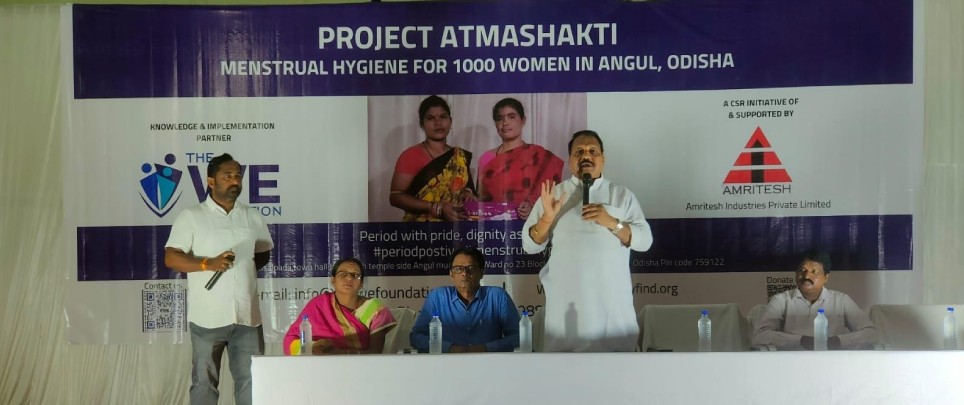
In the industrial town of Angul, Odisha, where many women juggle daily wage work, household responsibilities, and social expectations, conversations about dignity and choice have rarely centered on them. Project Atmashakti, an initiative of The WE Foundation, turns menstrual hygiene into a powerful doorway for women to discover their own strength, build solidarity, and step into economic and social leadership.
Working with self-help groups from low‑income settlements, Atmashakti invites women not just as beneficiaries but as drivers of the initiative. SHG members are trained to manage distribution, keep simple accounts, and speak confidently about dignity, rights, and financial decision‑making. What began as an effort to ensure access to sanitary products has grown into a platform where women negotiate better within their families, participate in community meetings, and see themselves as entrepreneurs rather than dependents.
In a basti near Madanmohanpada, Lakshmi had always followed others—signing where she was told, attending meetings but rarely speaking. Through Atmashakti, she became responsible for managing stock and payments for her SHG’s sanitary napkin distribution. The first time she balanced the ledger correctly, she describes feeling “as if someone switched on a light” inside her. Now, when local officials visit, Laxmi confidently explains the group’s work and income, and younger women come to her for guidance on savings and starting small ventures.
In another lane of Angul town, Sabitri, a 32‑year‑old mother of two, used to feel invisible at home and in the community. After joining Atmashakti’s discussions on self‑esteem and collective power, she realized how often decisions were made for her—about money, health, and even whether she could attend meetings. With quiet determination, she convinced her husband to let her travel to the town hall training, promising she would contribute to the household income. Today, Sabitri leads awareness circles in nearby hamlets, opening each session by saying, “We are not asking for permission to be respected; we are reminding others that we already deserve it.”
By rooting the project in SHGs, Atmashakti ensures that women support one another as they experiment with new roles—as distributors, speakers, and decision‑makers. They practice keeping records, planning outreach, resolving conflicts, and speaking to local leaders, building skills that go far beyond this single initiative. As their confidence grows, so does their influence: daughters stay in school longer, families prioritize girls’ needs, and communities slowly shed the shame and silence that once surrounded both menstruation and women’s aspirations.
Atmashakti is, ultimately, about the power that comes when women recognize themselves as capable, knowledgeable, and worthy of being heard. One ledger balanced by Laxmi, one bold conversation led by Sabitri, one SHG that shifts from passive recipients to active entrepreneurs—together, they are rewriting what it means to be a woman in Angul: not just enduring circumstances, but reshaping them with courage and collective strength.